
.jpg)
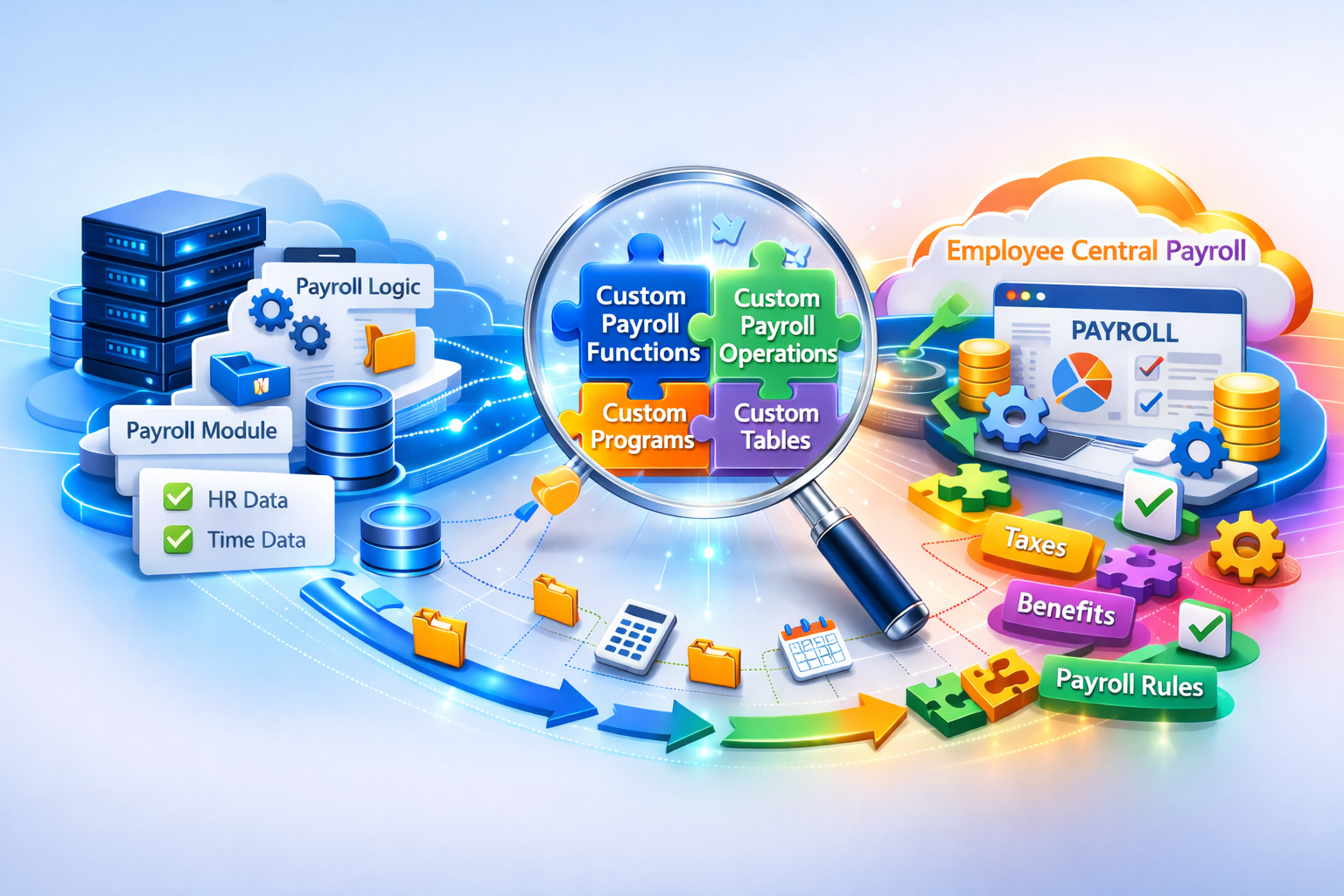
Migrating from SAP On-Premise Payroll to SAP SuccessFactors Employee Central Payroll is rarely just about moving data. In reality, most payroll systems carry years of accumulated knowledge. That knowledge sits not only in configuration and schemas, but also in custom developments that have been carefully introduced over time.
Among the most important of these are custom Payroll Functions and Payroll Operations.
For many organisations, these Workbench objects represent the practical reality of running payroll in complex environments. They often capture local legislative nuances, highly specific business rules, or operational scenarios that simply cannot be handled through configuration alone.
Until now, bringing those developments across during a migration to Employee Central Payroll has not always been straightforward. The latest enhancement to Nexus Move changes that by allowing organisations to selectively migrate Workbench objects from SAP On-Premise directly into Employee Central Payroll through automated transport creation. It is a small technical change on the surface, but one that adds significant practical value to payroll transformation projects.
Why Custom Payroll Functions and Operations Exist
SAP Payroll already provides an extensive set of standard payroll functions and operations. These form the backbone of payroll schemas and support the vast majority of calculations needed to determine gross pay, taxes, deductions, and net pay. Yet anyone who has worked closely with payroll systems knows that no two payroll environments are identical. Over time, organisations encounter scenarios where standard functionality cannot fully address a particular requirement. This might involve handling a complex award interpretation, integrating data from external systems, managing unique benefits structures, or supporting regulatory nuances specific to a region or industry. When those situations arise, payroll architects often introduce custom Payroll Functions or Operations.
Custom Payroll Functions typically encapsulate more complex logic. They may perform specialised calculations, evaluate external data, or manage processing steps that cannot easily be expressed within standard schema configuration. Payroll Operations tend to extend existing processing logic. They allow payroll specialists to manipulate wage types, evaluate conditions, or apply additional calculations within payroll schemas. Once implemented, these developments often become deeply embedded in payroll processing. In many cases they represent years of refinement, testing, and practical payroll expertise translated into technical logic. When organisations begin the move to Employee Central Payroll, the real question is not whether these objects exist. The real question is what should happen to them.
The Historical Challenge of Migrating Workbench Objects
Moving configuration data and employee master data between systems can be automated with well-structured migration tools. Workbench objects have traditionally been a different story.
Technical teams often needed to identify the relevant objects manually, create or manage transport requests, and ensure that dependencies were correctly included. In large payroll landscapes with extensive customisation, that process could quickly become complex. At the same time, transformation teams were often trying to answer a broader question. Which of these developments still serve a purpose in the future payroll environment?
Some custom functions and operations are essential to payroll accuracy. Others reflect historical workarounds that were created years earlier and may no longer be required. Without dedicated tooling, the effort involved in extracting and transporting Workbench objects could influence those decisions more than it should.
Selective Workbench Migration with Nexus Move
The latest enhancement to Nexus Move introduces a far more controlled approach. Users can now identify specific Workbench objects within the SAP On-Premise source system and instruct Nexus Move to generate a corresponding Workbench transport in the Employee Central Payroll system. That transport is then automatically placed into the ECP import queue, ready to be processed using the standard SAP transport management process. This is an important detail. Nothing about the existing transport governance changes. Approvals, sequencing, and standard transport procedures all remain in place. What changes is the level of control available during the migration itself. Instead of transporting entire packages or manually recreating developments, teams can focus on exactly the objects that need to move forward. The result is a cleaner and far more manageable transition.
Supporting Different Payroll Transformation Approaches
Every payroll transformation project has its own priorities. Some organisations want to retain as much of their existing payroll logic as possible. Their focus is stability and continuity. In these cases, being able to migrate existing Payroll Functions and Operations helps ensure that proven payroll calculations continue to operate exactly as expected. Other organisations see the migration as an opportunity to review their payroll landscape more closely. Over time, many payroll environments accumulate technical logic that no longer serves a clear purpose.
Selective migration makes this evaluation much easier. Teams can preserve the developments that genuinely add value while leaving behind those that no longer belong in the future system. The important point is that the decision becomes deliberate rather than technical. Nexus Move supports either approach.
Extending the Nexus Move Migration Framework
Nexus Move was originally designed to streamline the migration of SAP On-Premise payroll systems to SAP SuccessFactors Employee Central Payroll. It provides structured capabilities for replicating configuration data, converting employee data, and validating payroll results during the transition. Modules such as Data Conversion, Data Replication, Payroll Verification, and Process Automation ensure that migration activities are controlled, auditable, and repeatable throughout the project lifecycle . The addition of selective Workbench object migration extends that framework into another critical area. Technical payroll developments can now be managed alongside configuration and data migration within the same structured process. From a project perspective, that reduces manual coordination and removes another potential point of complexity.
A More Controlled Path to Employee Central Payroll
Payroll systems sit at the heart of organisational trust. Employees expect their pay to be accurate every time, and organisations depend on payroll systems to remain compliant with constantly evolving regulations.
Because of this, payroll transformation projects demand both precision and flexibility. Organisations need the ability to preserve the payroll logic that protects their operations while still modernising the underlying platform. Selective Workbench object migration helps strike that balance. It allows organisations to carry forward the payroll intelligence embedded in their existing systems while maintaining a structured and well-governed migration to Employee Central Payroll.
With this enhancement, Nexus Move continues to evolve into a comprehensive migration framework that supports not only data and configuration migration, but also the controlled transition of technical payroll developments.
If you’d like to find out more or organise a demonstration with either TIK or one of our Global Partners please feel free to Contact Us via the link below
.png)
.svg)

.svg)
.png)
.png)
.png)