
.jpg)

In your SAP HCM and Payroll environment, applying Enhancement Packs, Support Packages, and Legal Compliance Changes is essential to keeping your payroll accurate, compliant, and protected. Payroll legislation changes frequently, and SAP delivers ongoing legal updates to ensure your taxation rules, superannuation calculations, reporting structures, and Wage Type behaviour remain correct. Without these updates, your organisation will quickly fall out of compliance, increasing the risk of audit findings, penalties, and costly remediation.
These updates also strengthen the stability and security of your system. Support Packages include corrections to SAP’s standard code, performance improvements, and fixes for issues identified across the global customer base, while security patches protect your sensitive payroll data and system integrity. Applying updates regularly prevents the build-up of technical debt and avoids the heightened regression risk that occurs when environments fall too far behind.
By staying current, you also keep your environment aligned with SAP’s supported release levels and ensure compatibility with modern tools, integrations, and automation platforms. Regular updates safeguard your payroll operations, reduce future upgrade effort, and provide your organisation with a stable, compliant foundation for ongoing HCM and Payroll activities. The next step is understanding how to safeguard your environment when these updates are applied, which begins with a disciplined, full regression testing approach.
How Full Regression Testing Protects Payroll Accuracy and Compliance
Applying Enhancement Packs (EHPs), Support Packages (SPs), or Legal Compliance Changes (LCCs) in SAP HCM and Payroll environments is not a routine maintenance exercise. It is a high-stakes operation that can impact payroll accuracy, compliance, and financial integrity across the enterprise. These updates introduce systemic risks that ripple through interconnected processes, making full regression testing not just advisable but mandatory. In this article, we explore why regression testing is critical, the risks inherent in SAP updates, and how the Nexus Suite by TIK enables organisations to achieve comprehensive, efficient, and auditable regression testing through its Data Replication, Payroll Verification, and HCM Reporting Modules.
Why Payroll Updates Are Mission-Critical
Payroll is the backbone of financial and legal integrity. Accuracy is non-negotiable because payroll errors have immediate and severe consequences. Unlike defects in other modules, payroll failures translate directly into compliance breaches, employee financial distress, back-pay claims, and penalties from regulatory agencies. When an update destabilises payroll logic or integration points, the organisation faces reputational damage and financial exposure. SAP updates such as EHPs, SPs, and LCCs are designed to improve functionality and maintain compliance, but they also modify standard schemas and rules, overwrite objects, and introduce new logic that can disrupt existing processes. This complexity demands a rigorous approach to validation.
The Risk Landscape
The first major risk lies in custom code. Most mature SAP ECC and S/4HANA PCE environments are heavily customised with Z-code tailored to unique business requirements. EHPs and SPs frequently modify standard SAP objects upon which these customisations depend. Without proactive analysis and testing, custom objects will inevitably break or behave unpredictably. In cloud environments like SuccessFactors Employee Central Payroll (ECP), SAP explicitly states that it does not QA the impacts of custom code. Clients are fully responsible for ensuring that updates do not introduce unexpected results. Hidden technical failures compound this risk. Corruptions can reside deep within the system, such as inconsistencies in standard includes or missing Data Dictionary objects after an HR Support Package (HRSP) implementation. These issues often surface only when a wide variety of systemic flows are exercised, underscoring the need for full regression testing.
Cross-module integration adds another layer of complexity. Payroll is not an isolated process; it is an accounting function that feeds directly into Financial Accounting (FI) and Controlling (CO). The posting of payroll results to the General Ledger is a critical failure point. Any modification by an SP or EHP can destabilise this delicate interface. A common failure mode is siloed testing, where the payroll run is validated but downstream FI/CO postings are neglected. If the posting program fails, the organisation cannot close its books, leading to major financial reporting delays and audit exceptions.
Legal compliance changes introduce further risk. LCCs often require complex modifications to payroll schemas and statutory reporting logic. These changes must be applied retroactively to previous payroll periods, making retroactive validation essential. Testing must ensure that new legal logic accurately processes historical data without generating erroneous retroactive payments. Failure to successfully apply LCCs or update compliance rules results in regulatory drift, where the system generates inaccurate or outdated reports, leading directly to audit failures.
Why Full Regression Testing Is Non-Negotiable
Targeted testing is insufficient because defects often manifest unpredictably across seemingly unrelated processes due to the interwoven nature of SAP modules. Regression testing acts as a safety net, proactively looking for unexpected systemic consequences rather than simply confirming that a specific fix worked. When changes affect core architecture, as with EHPs, or when legislative changes necessitate wide-ranging validation, as with LCCs, complete regression testing is required. Modern SAP landscapes often use hybrid architectures, such as SuccessFactors Employee Central for Core HR integrated with ECP or S/4HANA PCE for payroll. These systems operate on mismatched, frequent release cycles, demanding almost continuous quality assurance efforts. This acceleration of required testing cadence elevates the necessity for efficient full regression testing to combat update fatigue caused by multiple annual releases.
In addition to SAP-delivered updates, organisations must also account for BAU-driven changes such as award updates, enterprise agreement variations, new allowances, configuration refinements, and other internal HCM or payroll projects. These changes can alter payroll schemas, rules, or integration points in ways similar to Support Packs or Legal Changes, and therefore require the same level of regression testing rigour. By incorporating BAU changes into the regression testing cycle, organisations ensure ongoing payroll stability and prevent downstream compliance or financial reconciliation issues.
How Nexus Suite Enables Full Regression Testing
The Nexus Suite by TIK provides a structured, automated approach to regression testing through three key modules: Data Replication, Payroll Verification, and HCM Reporting. Together, these modules deliver a comprehensive framework for validating SAP updates across hybrid landscapes.
The Data Replication Module addresses one of the most significant challenges in regression testing: creating realistic test environments. Accurate testing requires production-like data, but copying entire clients is time-consuming, costly, and fraught with privacy risks. The Data Replication Module replicates employee master data and payroll results across SAP instances without manual client copies. It scrambles sensitive data using configurable, country-specific logic to meet GDPR and privacy requirements while preserving the logical integrity needed for complex payroll calculations. It supports targeted replication scenarios, enabling subsets of data for focused testing, such as high-risk payroll areas or specific employee groups. Full audit trails ensure transparency and compliance. This capability allows organisations to simulate production conditions and validate changes without compromising original data, reducing environment setup time from weeks to hours.
The Payroll Verification Module automates the comparison of payroll results before and after updates. Manual verification using spreadsheets and queries is labour-intensive and error-prone. Nexus eliminates this inefficiency by comparing payroll results across systems, whether SAP-to-SAP or SAP-to-legacy, with minimal configuration. It defines tolerances and mapping rules for wage types and payment codes, generates comprehensive reports for anomalies, and enables root-cause analysis. This safeguards against EHPs, SPs, and LCC impacts, ensuring no hidden calculation errors propagate into live payroll. By automating verification, Nexus reduces effort from weeks to hours while providing auditable, repeatable processes that meet compliance requirements.
BAU Regression Testing Process Using the Nexus Suite
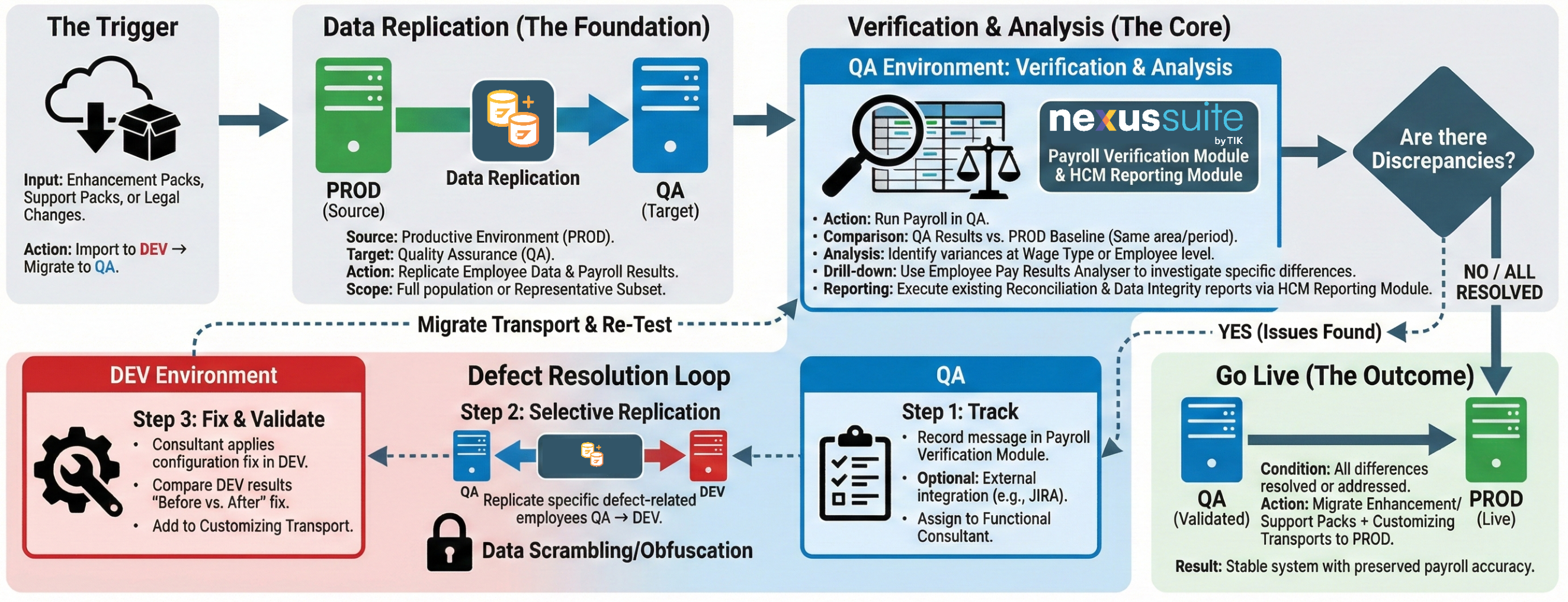
The Nexus Suite is used to ensure that any changes introduced through EHP's, SPs, or LCC updates do not negatively impact the existing productive payroll calculations. This process provides a structured and auditable approach to confirming payroll consistency and accuracy following any system update. When EHP's, SPs, or LCC are released, it is first imported into the Development (DEV) environment and subsequently migrated through to the Quality Assurance (QA) environment. Once the updates are available in QA, the Nexus Suite is used to replicate the required employee data including their payroll results from the Productive(PROD) environment into the QA environment. Depending on the size of the customer’s workforce, this replication can include the entire employee population or a representative subset of employees.
After replication is complete, payroll is run within the QA environment. The Payroll Verification Module is then used to perform a detailed comparison between the payroll results in the QA environment and those in the Productive (PROD) environment for the same payroll area, period, and employee selection. This comparison ensures that the calculated pay values in QA are consistent with the established PROD results. Any variances identified during this verification are analysed within the Payroll Verification Module itself. Each difference can be examined at the Wage Type, Employee, or Wage Types associated with an Employee level, allowing users to identify specific issues that may impact all employees or are related to a specific employee’s allowances, deductions, or other pay elements.
During the analysis process, the HCM Reporting Module plays a key role in providing in-depth visibility into payroll outcomes. Within the Payroll Verification Module Analysis screen users can drill-down directly into each employee’s payroll results to investigate specific differences identified during verification through the Employee Pay Results Analyser. This integrated view allows analysts to assess the impact of configuration changes or system updates on individual Wage Types and overall payroll accuracy. Additionally, all reconciliation and data integrity reports that you’ve already created within the HCM Reporting Module that are used by your Organisation can be executed as part of the regression testing process. These reports, delivered through the HCM Reporting Module, enable another level of comprehensive verification of payroll integrity, configuration consistency, and data accuracy across systems without the need for external tools.
Where discrepancies exist, resolution messages are recorded directly within the Payroll Verification Module and can also be tracked in an external quality management system such as JIRA. This enables full traceability of defects throughout the testing lifecycle. Each defect is assigned to afunctional payroll consultant who is responsible for the further analysis and resolution of each issue in the DEV environment. Resolution typically involves making configuration-based adjustments and adding these changes to a nominated Customizing Transport. To validate that a fix is effective, prior to releasing the transport, the functional consultant uses the Nexus Suite to replicate the relevant employees referenced in the defect record from QA into DEV. During this process, Nexus can scramble or obfuscate sensitive employee information using country and language-specific scrambling routines, ensuring compliance with data protection requirements. Payroll related data itself is not scrambled, enabling the consultant to perform a precise comparison of payroll results before and after any configuration change. This ensures that the fix implemented in DEV will correct the issue identified in QA.
Once the configuration changes have been verified in the development environment, the corresponding transports are migrated into the QA system. Payroll is then re-run in QA, and another payroll verification comparison is performed, this time between the updated QA results and the productive payroll baseline. The Nexus Suite provides full traceability of progress during this process, allowing testers to track which issues have been resolved and which remain outstanding. If the issue hasn't been resolved the associated resolution message is automatically copied from the previous analysis run results to the current analysis run results. When all differences in the current analysis run have been successfully resolved and any negative impacts to the payroll results have been resolved or sufficiently addressed, the relevant Customizing Transports may be migrated into Production once either the EHP, SP, or LCC transports have been migrated into production first. This ensures that the system remains stable and that payroll accuracy is fully preserved after all updates have been applied.
Through this process, the Nexus Suite delivers a controlled, transparent, and highly efficient approach to BAU regression testing. It enables customers to maintain confidence in their payroll integrity following any system change by providing automated data replication, comprehensive payroll verification, advanced HCM reporting, and a complete audit trail of testing and resolution activities from start to finish.
Efficiency and ROI
Manual regression testing is time-consuming and cannot keep pace with frequent release cycles. Nexus Suite delivers up to 99% time savings in environment setup and replication, more than 80% reduction in verification effort compared to manual methods, and rapid report generation without custom development. These efficiencies translate into significant cost savings and risk reduction for every update cycle. Organisations can reallocate resources from repetitive regression testing tasks to strategic initiatives, improving overall agility and resilience.
Strategic Measures for Continuous Assurance
To manage the demands of full regression testing, especially with accelerated cloud releases, organisations must adopt strategic measures. Test automation is a compliance prerequisite because manual testing cannot keep up with quarterly release cycles. Risk-based testing frameworks prioritise efforts based on potential disruption severity, focusing resources on critical areas such as high-volume employee populations or statutory deduction calculations. Secure test data management ensures compliance with privacy regulations while maintaining data integrity for accurate testing. Nexus Suite supports these strategies through integrated modules that automate replication, verification, and reporting within a secure, auditable framework.
Applying EHP's, SPs, or LCCs to your SAP payroll system is not like changing a lightbulb. It is like rewiring a skyscraper. You cannot just check the room where you made the splice; you need a comprehensive, automated safety check across every connected circuit, including the lights, the lifts, the security system, and the fire alarms. In SAP terms, that means HR data, time management, finance posting, and statutory reporting. Nexus Suite provides that safety net, ensuring stability, compliance, and confidence in every update.
Ready to de-risk your SAP updates? Contact us to learn how Nexus Suite can transform your regression testing strategy.
.png)
.svg)

.svg)
.png)
.png)
.png)